‘The new rules are more suited to the way we live and work’
‘The new rules are more suited to the way we live and work’
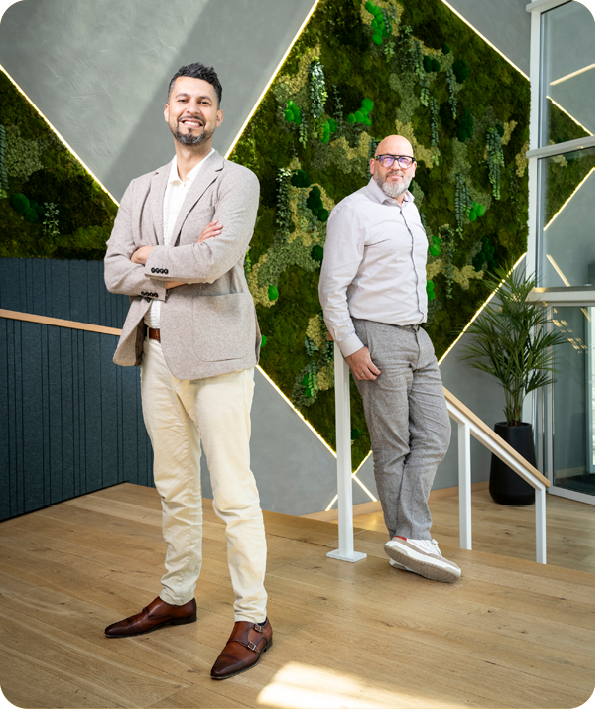
PME intends to switch to the new pension rules on 1 January 2027. From that time onward, a new pension scheme will apply. Alae Laghrich, chair of PME’s executive board, and pension consultant André Nijhuis look back and ahead.
Why have new pension rules been introduced?
André: ‘There are three reasons for this. The first is that pensions could not be increased for a long time, despite the fact that the economy has been doing quite well for years. That feels unfair, because we’ve all noticed that life is getting more and more expensive. Under the new rules, we will no longer need to maintain big buffers, meaning pension funds can distribute money to people quicker. The second reason is that the old rules no longer fit the way we live and work now. For example, we see that people work for one employer for a few years and then move on to the next job, perhaps in another sector. People might also start their own business, or work part time for a while because it suits their family life better. The new rules are more suited to these changes. The third reason is to make pensions clearer and more personal. Employees will soon be able to see exactly how much money goes into their pension and what it will yield.’
Alae: ‘The Netherlands has one of the best pension systems in the world. The new rules will ensure that this continues to be the case in the future.’
What will people notice?
André: ‘We will keep what works well and adjust what can be improved. Gains and losses will be shared collectively, as well as major risks, and you will receive a pension for as long as you live, just as you do now. What will change is that there will be agreements about the monthly contributions, rather than how much pension you will ultimately receive.’
‘The aim is for the switch to work out as fairly as possible for everyone.’
ALAE LAGHRICH
Alae: ‘As André has just said: when you start receiving your pension, it will increase more easily. The other side of the story – let’s be fair – is that the pension can also be decreased, just as it can now. That is why we have three protective measures in place. These protect your pension, making it less likely we will need to decrease it, but not entirely impossible.’
Has PME itself determined what the new scheme will look like?
Alae: ‘No, the agreements for the new pension scheme have been made by the employees’ and employers’ organisations, referred to as social partners. These agreements were documented in a transition plan. PME subsequently carefully examined whether the agreements were realistic and feasible. And we asked ourselves: are they fair to all groups? The consequences were investigated extensively. We also looked at groups that might be disadvantaged. After all, this disadvantage should be compensated, where possible. We aim to make the switch as fair as possible for everyone.’
Will I gain anything as a result of the switch?
André: ‘That will in part depend on PME’s coverage ratio. This is an indication of how we are doing financially. At the very least, we want to maintain the pension at its current level, and we would prefer to increase it. The higher the coverage ratio at the time of the switch, the more we can do.’
Alae: ‘We have taken measures to keep our coverage ratio as stable as possible until the switch. As a result, we are less sensitive to interest rate fluctuations and declines in the value of our shares.’
André: ‘Things are looking good at the moment. The coverage ratio has been fairly stable recently or is even rising slightly, despite all the turmoil in the world. I often notice that people are positively surprised by this.’
André, you just said that life is getting more and more expensive. Will the pensions that are being paid out keep up with the increase in prices?
André: ‘The new scheme will make it easier to increase your pension. Still, there is a good chance that prices will rise even more. In that case, the purchasing power of your pension will decrease.’
‘We’ve gone from suspicion to trust. That’s great to see.’
ANDRÉ NIJHUIS
Alae: ‘The reason we don’t expect pensions to fully keep up with rising prices is due to the protective measures we will be implementing. These ensure that the risk of decreases is limited. However, opting for a fairly high degree of security leaves less room for growth. In other words, security costs money. We want to be honest about that, and people will see that reflected in the calculation they will receive from us in October or November.’
How do you look back on the past period?
Alae: ‘I am proud of all the people involved in this switch. We are working really hard behind the scenes. I also feel that we have a huge responsibility. The switch to the new rules is the biggest change in the history of the Dutch pension system. It’s quite demanding. After all, every choice we make has an impact on people. We keep asking ourselves: are we doing right by everyone who has a pension with us? We want our choices to work out well. For young starters, for centenarians and for everyone in between. It’s their money that we manage and we take this duty seriously.’
André: ‘At first, quite a few people were sceptical about the new rules. When the first pension funds made the switch, they noticed the benefits. That really was a tipping point. There were fewer concerns, and now I have very different conversations about pensions. We’ve truly gone from suspicion to trust. That’s great to see.’ ●
Photo: Harmen de Jong
This is what the accountability body has to say about the switch
Arjen Kronenberg and Bert Aal are members of the accountability body. They represent the people who accrue a pension at PME.
Arjen: ‘I think it’s important that the new rules are fair for everyone, whether you are receiving or accruing a pension.’
Bert: ‘The switch to the new pension rules must be fair for everyone. Now, there is a single pot of money that will be distributed: everyone gets a share. This distribution is the biggest challenge in transitioning to the new rules. This is something that we, as the accountability body, pay close attention to. I am confident that the new rules are better than the ones we have now.’
The role of the accountability body
The accountability body advises PME’s board on certain topics, such as the switch to the new pension rules. The board also has to explain to the accountability body how it made certain decisions. The accountability body reviews all of this and reports on it in the annual report.